Using Carpet Tiles as a Spatial Design Tool
Good wayfinding is often something we barely notice.
In a well-designed workplace, materials, colour, lighting, geometry, and texture provide visual cues that help us understand where to move, when we're entering a new space, and when we've reached a destination. Signage has an important role, but it shouldn't have to do all the work.
For interior designers and specifiers, carpet tiles offer an opportunity to integrate wayfinding. Pattern can support circulation, colour can identify destinations, tonal transitions can distinguish workplace areas, and changes in tile orientation can suggest direction.
With collections such as Burmatex Surface Trace and Milliken Pattern Play, flooring can become part of an interior's navigational language rather than simply the finish beneath it.
Designing Wayfinding into the Interior Scheme
Wayfinding is about more than getting people from A to B. It's about making the hierarchy of a space easy to understand.
Within a contemporary office, primary circulation needs to read differently from secondary routes. Meeting as well as collaboration spaces should feel like destinations, while transitions to focused work areas may need to be quieter and less pronounced. Carpet tiles can articulate each of these conditions without introducing physical boundaries.
A directional pattern is able to reinforce a primary route. Carpet tiles can emphasise an axis. A contrasting field of colour can identify a destination, while more subtle tonal variations can distinguish workplace neighbourhoods without fragmenting the overall scheme.
The most successful applications are rarely literal. A coloured line through an office might provide direction, but pattern, orientation and material transitions can achieve the same result in a much more integrated way.
The important consideration is how the flooring relates to the wider interior architecture. Aligning carpet patterns with lighting, ceiling features, joinery and furniture planning creates a stronger visual cue than treating the floor as a separate graphic layer.
When all of those components share a common geometry, wayfinding becomes intuitive rather than instructional.
Creating Destinations as Well as Routes
Wayfinding isn't only concerned with movement. It also needs to communicate arrival. This is particularly relevant in open-plan offices, where meeting areas, project spaces, and collaboration settings increasingly sit within larger continuous floorplates.
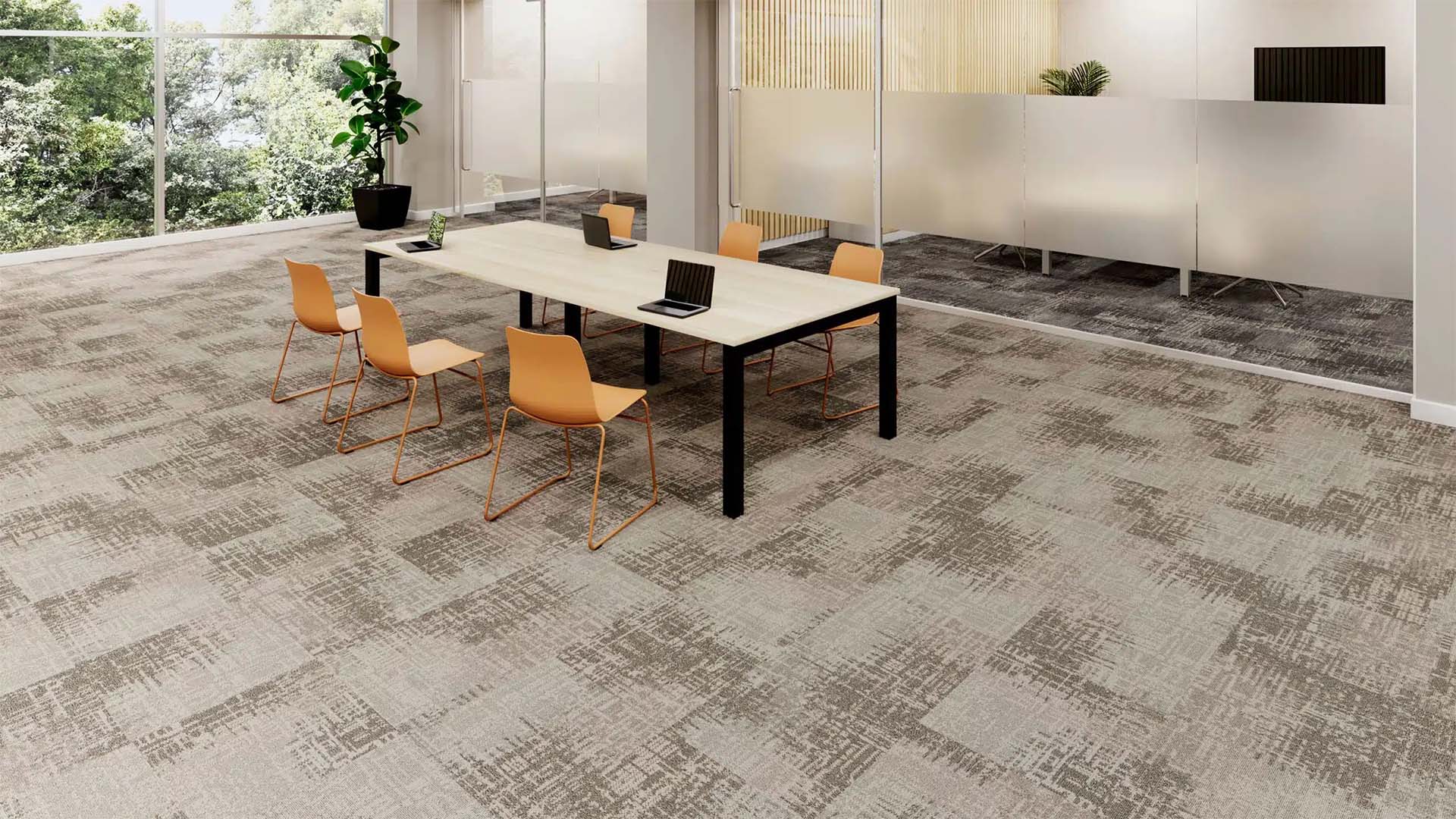
Consider a collaboration table placed within an open workspace. On the same continuous carpet as the surrounding desks, it remains visually part of the larger space. Introduce a change in carpet tile beneath it, and the area immediately acquires its own identity. The flooring creates an edge without requiring a wall or screen.
This technique can be applied to breakout areas, communal spaces, meeting settings and reception seating. It allows designers to establish destinations while retaining sightlines and the flexibility of the wider design scheme.
The question then becomes one of character: how strongly must that destination announce itself?
That's where the contrasting design possibilities offered by Burmatex Surface Trace and Milliken Pattern Play become particularly interesting.
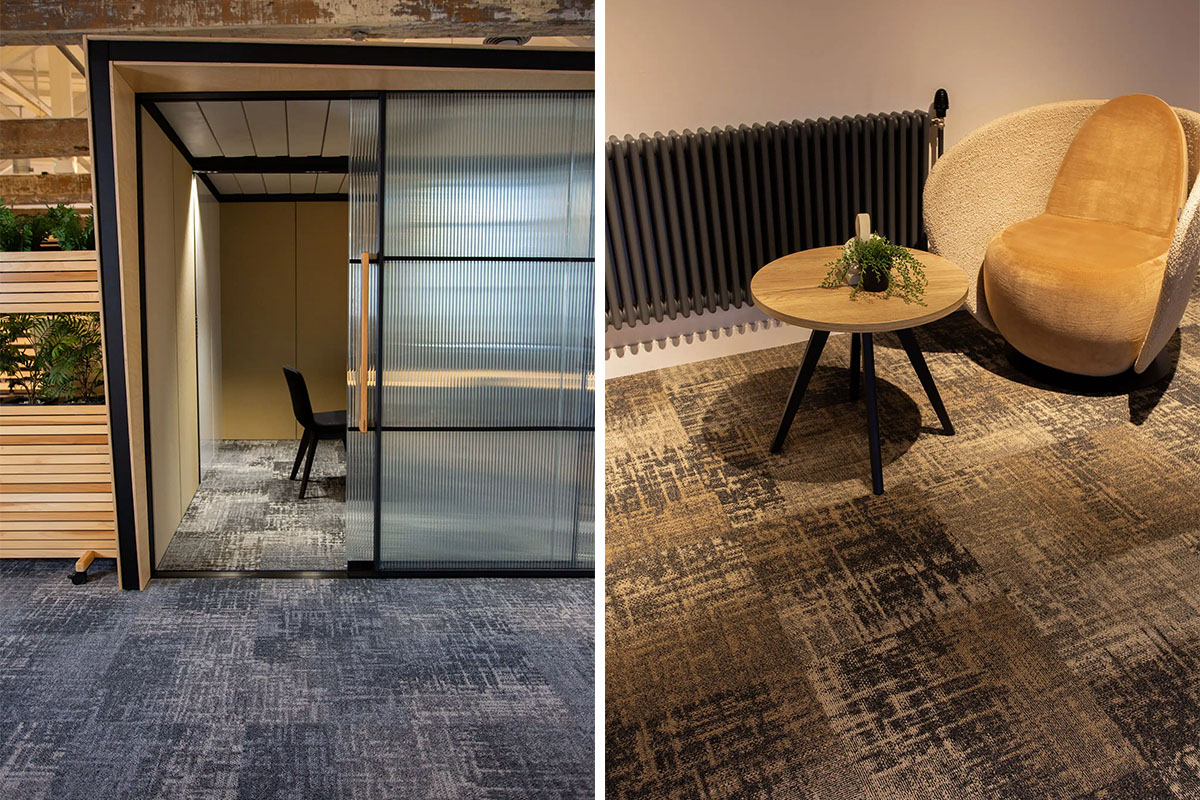
Burmatex Surface Trace: Wayfinding Through Texture and Tone
The latest Surface Trace carpet tile collection from Burmatex delivers a more understated approach to spatial definition.
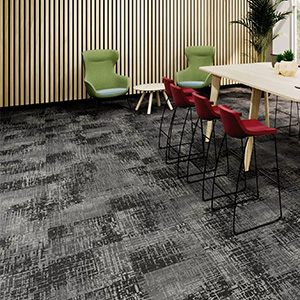
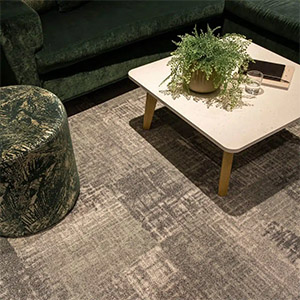
Inspired by traditional weaving and handmade textiles, Surface Trace uses a multilevel loop construction to create a tactile, textural surface. Its palette of 12 elevated neutrals spans warm and cool tones, giving designers the ability to work with relatively gentle transitions in colour. Significantly, Surface Trace is Burmatex's first random-lay carpet tile.
From a wayfinding perspective, the absence of strong directionality can be an advantage. Not every part of a floor needs to tell people where to go. Sometimes flooring needs to communicate that they have arrived.
Surface Trace can create a continuous textural field beneath a meeting area, lounge or working spaces. Used alongside a more linear or directional flooring treatment, the contrast can indicate a change in function without requiring an obvious border.
This makes the collection particularly relevant to workplace interiors where the material palette is deliberately restrained. Wayfinding can emerge through texture, tone, and contrast rather than overt graphics or colour coding.
There is also a strong material specification story. Surface Trace incorporates Universal Fibers Thrive matter yarn and Burmatex's BioBase recycled backing. Burmatex reports 72.7% total recycled content and a Global Warming Potential of 3.71 kg CO2e. For specifiers considering environmental performance alongside aesthetics, these credentials provide another dimension to the specification.
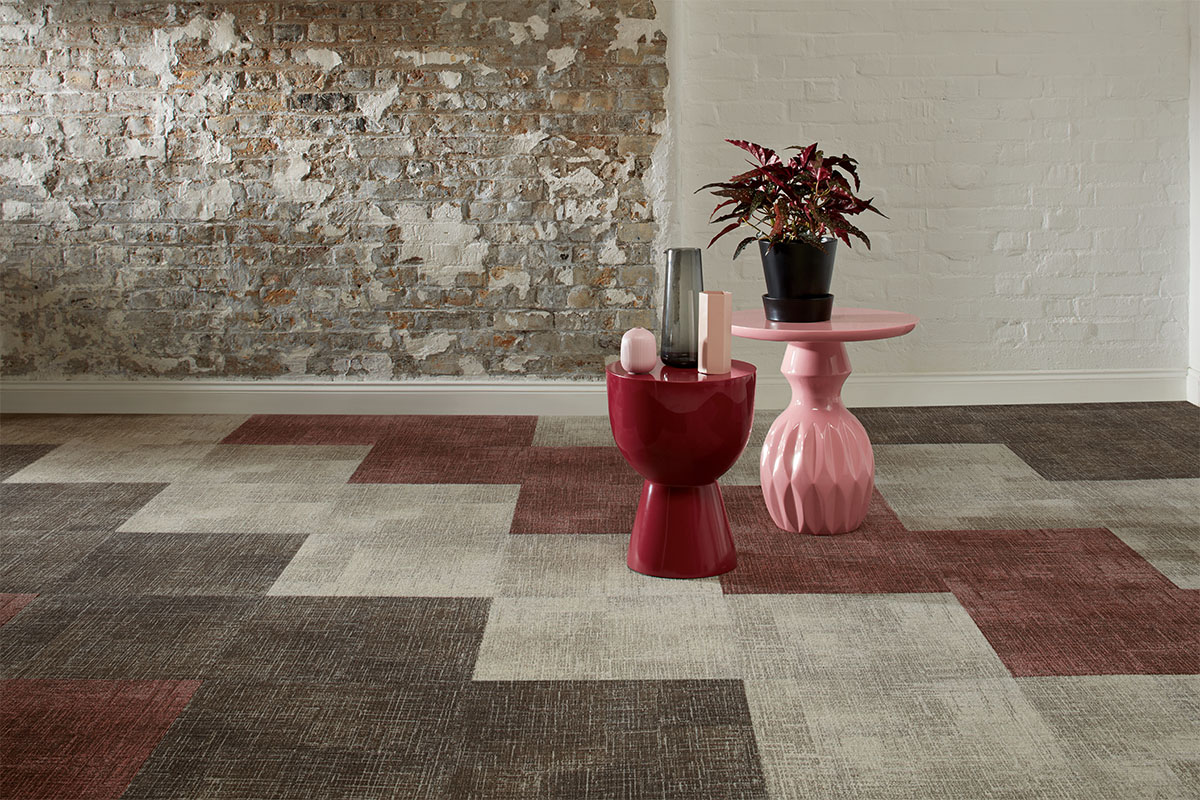
Milliken Pattern Play: Making Pattern Part of the Navigation
At the more expressive end of the spectrum, Milliken's Pattern Play carpet tile collection offers designers a distinct set of tools.
Inspired by the New London Fabulous Movement, Pattern Play explores colour, pattern and geometry across the floor plane. The collection incorporates Pattern Play, Transitions and Shapes, each supplying opportunities for wayfinding and zoning.
Transitions is particularly interesting for workplace design. Rather than creating an abrupt junction where one carpet stops and another begins, gradient effects can move between colours. This gives designers the ability to communicate progression: colour or pattern can become more pronounced as someone approaches a meeting hub, communal area or other destination.
There is no hard line marking where this space starts. Instead, the floor shifts as the interior experience changes.
Shapes features a more graphic approach. Geometric forms can create focal points, identify landmarks or give individual settings their own character within a larger floorplate.
With more than 70 colours available across Pattern Play, designers also have considerable scope to develop a coordinated wayfinding palette. Milliken offers colour customisation and custom shapes, opening further possibilities for schemes developed around a project's material or brand identity.
The key is to use that choice systematically. Colour should communicate something rather than simply decorate the floor.
Designing the Transition
The junction between two flooring treatments is often as important as the products themselves. Traditional zoning tends to create hard boundaries: one carpet stops and another starts. But contemporary workplace plans are increasingly fluid, and flooring can reflect that.
Gradual transitions allow spaces to overlap visually. Pattern can become denser as someone approaches a destination. A random-lay texture can replace a more directional design as movement gives way to occupation.
This suggests an interesting relationship between Surface Trace and Pattern Play.
A directional or gradient treatment from Pattern Play could help establish movement along a circulation route, while the random-lay character of Surface Trace could identify a quieter destination or meeting setting. The products don't necessarily need to be used together, of course, but they illustrate the different roles flooring can play within a wayfinding strategy.
Workplace Teams and Colour
The growth of workplace teams makes this approach especially relevant.
Rather than organising offices simply as rows of desks and enclosed rooms, many schemes now group settings around teams, activities or different modes of working. Flooring can help give those neighbourhoods an identity without designating a different carpet to each one.
Related tones can create subtle differentiation, while stronger colours or patterns are reserved for shared destinations and primary routes. Over time, these visual indicators become part of the user's mental map of the workplace.
This same principle applies to brand colour. Instead of covering a large area in a corporate colour, a more considered scheme might introduce it at key decision points or destinations. Pattern Play's extensive palette lends itself to this more graphic approach, while Surface Trace offers a quieter alternative for schemes where texture and materiality need to take precedence.
Let the Floor Do Some of the Talking
For interior designers and specifiers, carpet tiles deliver a versatile way to make wayfinding part of the interior architecture rather than something applied afterwards.
Burmatex Surface Trace demonstrates how texture, tonal variation and random-lay installation can create subtle spatial signals and establish destinations. Milliken Pattern Play takes a more expressive approach, using colour, gradients and geometry to communicate movement and identity. Both point towards the same principle: that wayfinding doesn't always need another sign.
When flooring works alongside lighting, furniture, architecture and graphics, the space itself can tell people where to go, and let them know when they've arrived.
Specifying Carpet Tiles for Workplace Wayfinding
Flooring Providers works closely with architects, interior designers and commercial flooring specifiers across Ireland, providing access to commercial carpet tile collections from manufacturers including Burmatex and Milliken.
For projects where flooring forms part of the wayfinding, zoning or wider workplace design strategy, our team can assist with samples, colour and pattern selection, product comparisons and technical specification.
Contact Flooring Providers to explore Burmatex Surface Trace, Milliken Pattern Play and other commercial carpet tile options for your next project.
If you enjoyed reading this, you may like Supporting Colour Trends With Flooring