Cork Flooring in Commercial Interiors
Why Cork Flooring is Gaining Ground in Commercial Interior Design
In commercial interiors, whether offices, hotels, retail, wellness spaces or hospitality settings, flooring must balance aesthetics, durability, comfort, and performance. Cork flooring is increasingly embraced by designers and specifiers for its unique combination of qualities that meet these demands. Underpinned by advances from industry leaders such as Wicanders, contemporary cork solutions are far more robust, versatile, and design-capable than many assume.
Below, we explore the key benefits and considerations when specifying cork flooring in commercial projects, and how modern cork systems are pushing boundaries in performance and sustainability.
Acoustic Excellence: Reducing Noise & Footfall Impact
One of cork’s most compelling advantages in commercial settings is its inherent acoustic performance. Because cork is composed of millions of tiny air cells, it acts as a natural sound absorber. According to Wicanders, cork floors can reduce walking sound (footfall noise) by up to 53% compared to laminate floors.
In multi-storey buildings, this dual benefit is useful: reducing noise within a room (echo, footsteps) and dampening transmissions between levels (impact noise). Cork flooring is especially suited for open-plan offices, hospitality corridors, meeting rooms, or wellness zones where acoustic comfort is vital.
Thermal Insulation & Comfort Underfoot
Cork also performs well thermally. Its structure provides natural thermal insulation, retaining heat and feeling warmer, even when barefoot. Wicanders highlights that cork floors are more efficient than wood, vinyl or ceramic in resisting heat loss.
From a human interface perspective, cork offers cushioning (a little give under load), reducing stress on joints, aiding comfort during prolonged standing or walking. Wicanders emphasises this “walking comfort” as one of cork’s health benefits.
In commercial interiors where user comfort is a priority, for example, hotel lobbies, spa zones, showrooms, or experiential retail, cork flooring can help soften the experience without sacrificing durability.
Durability & Performance with Modern Technologies
Traditional perceptions sometimes cast cork as too soft or delicate for heavy-use environments, but modern innovations have strengthened its case.
- Resilient recovery: Cork’s elasticity and compressibility allow it to adapt to pressure and recover, without losing flexibility or permanently deforming easily. Wicanders notes that cork can adapt under load and regain its shape.
- Protective surface: technologies: Advances such as HRT (High Resistance Technology) finishes and more durable surface coatings help resist scratching, stains, and wear, enabling cork to survive in moderately trafficked commercial zones.
- Waterproof cork systems: Some newer cork systems offer 100% waterproof construction while still retaining cork’s performance attributes, enabling use in areas traditionally off-limits for cork, such as kitchens, bathrooms, or wet zones.
Sustainability, Indoor Air Quality & Green Credentials
For many commercial projects today, sustainability is non-negotiable. Here, cork flooring holds distinct advantages:
- Renewable & regenerative: Cork is harvested from the bark of cork oak trees without felling them. Trees regenerate their bark every ~9 years, making cork a truly renewable resource.
- Low emissions & indoor air quality: Wicanders products undergo stringent testing, their cork floors comply with strict indoor air quality standards, having been tested for over 2,000 potential chemical emissions.
- Negative carbon balance potential: Some cork products are promoted as having negative carbon balance, meaning that through their life cycle, they may sequester more carbon than is expended in their production (depending on sourcing, transport, etc).
PVC-free options: Recent cork flooring ranges (such as Wicanders) are marketed as 100% PVC-free, further enhancing their ecological credentials.
Design Versatility & Pattern Freedom
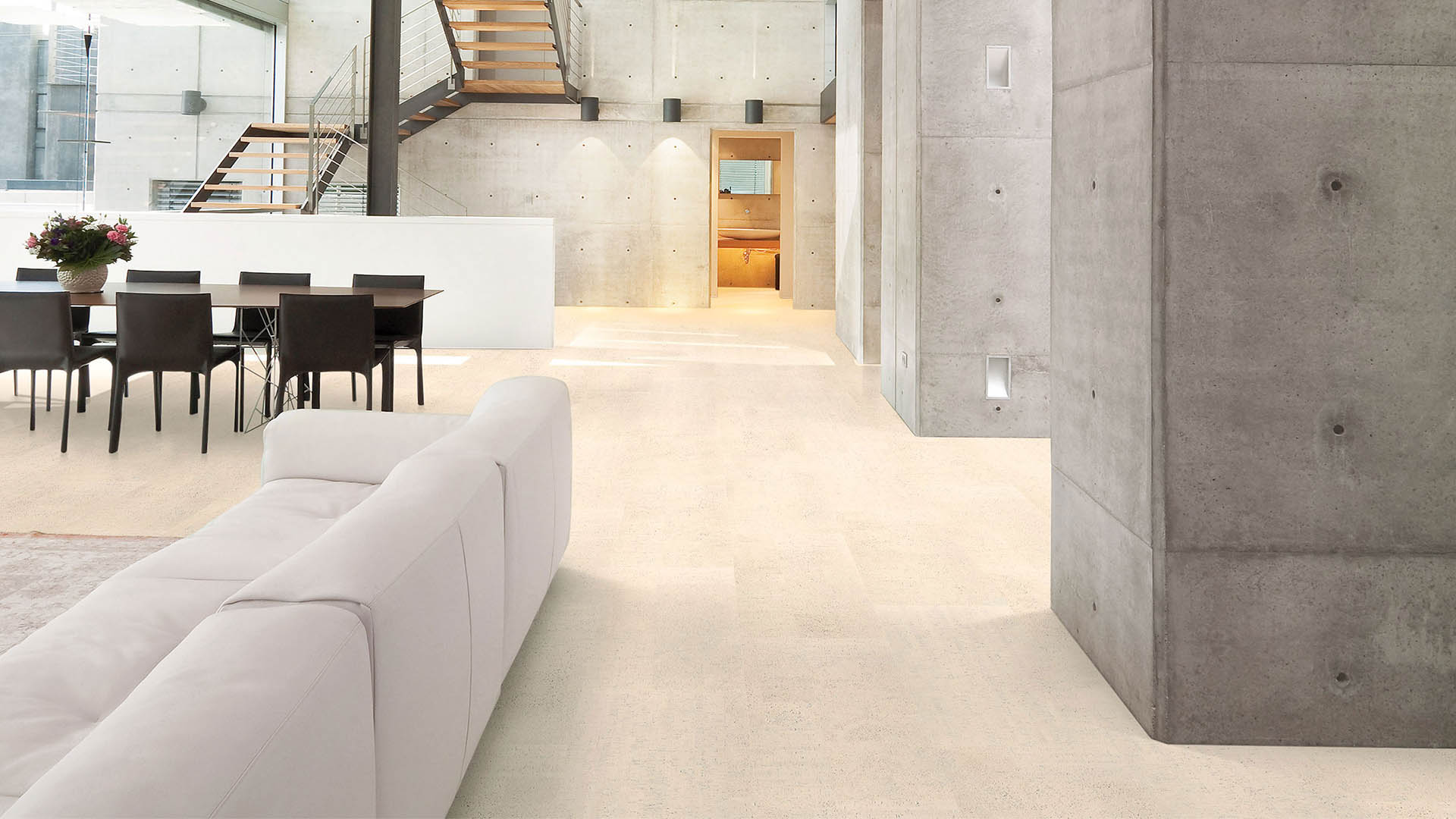
Cork no longer must be limited to plain tile or plank forms. Modern cork flooring systems support creative pattern play, colour variation, inlays, and mixed visuals. With digital printing and modular formats, specifiers can integrate cork in bold installations, zonal delineation, or as feature flooring.
For example, Wicanders cork ranges are available in wood-look visuals, stone aesthetics, and unique cork textures, allowing designers to include cork as a design feature rather than a back-drop.
In contract settings, this design flexibility means cork can be used in lobbies, breakout areas, meeting rooms, and corridors to echo brand identity, guide flow, or highlight zones.
We can provide practical and project-focused advice to help you incorporate a cork floor into your next project, or visit us at our Dublin showroom to experience the range and samples.